Tuesday, 30 September 2008

Going South ...
 Greg then took us on a bit of an adventure to deepest South London: Elephant and Castle, to view Roger Hiorn's Artangel Project, Seizure. I love Artangel projects for their sheer ambition and uncompromising commitment to the artists' vision. Seizure did not disappoint. We were all fairly tired when we reached the site: a derelict housing estate just off the New Kent Road. Bemusedly, we donned wellington boots and gloves as instructed before entering a disused ground-floor flat.
 Neither images nor video can do justice to this installation - you really do have to be there. The artist has coated the entire interior of the space - walls, floors, ceilings, fixtures and fittings - with dazzling blue copper sulphate crystals.
 On one level, this is such a simple intervention - resurfacing a found object (a favourite working method of Hiorn), and, of course, the apparent simplicity belies the technical challenges of making the space water-tight and filling it to the brim with a supersaturated copper sulphate solution - but the word which keeps popping into my head to describe the result is "spiritual" (this, from a hard-headed, logical/scientific type!). We were all struck by how hushed everybody became when they entered the rooms, and afterwards several of us commented on how refreshed we felt by the experience ... ready to face the rest of the day.
A programme of talks accompanies this project, including the artist Roger Hiorns in conversation with Michael Stanley at the Jerwood Space on Tuesday 14 October. Full details on the Artangel website.
Frank Gehry and Gerhard Richter at the Serpentine
 We left the Dana Centre and met Greg Epps, who accompanied us as we walked up Gloucester Road and through Kensington Gardens to the Serpentine Gallery. Here, we enjoyed a relaxing lunch in the 2008 Gallery Pavillion, designed and engineered by Frank Gehry in collaboration with Arup.
"Gehry and his team took inspiration for this year’s Pavilion from a fascinating variety of sources including the elaborate wooden catapults designed by Leonardo da Vinci as well as the striped walls of summer beach huts. Part-amphitheatre, part-promenade, these seemingly random elements make a transformative place for reflection and relaxation by day, and discussion and performance by night."
Opinions of the structure were mixed. Some did not like the "blocky" appearance or the "cheap pine" look of the wood. Others loved the way the light came through in soft dappled stripes.
Carl Collins, CAD manager at Arup Associates (N.B. not the part of Arup associated with this project) said: "It reminds me of a flat-pack shed I once built ... I like it!"
After lunch, we had a quick look round the current exhibition in the gallery: Gerhard Richter's 4900 Colours: Version II
"4900 Colours comprises 196 square panels of 25 coloured squares that can be reconfigured in a number of variations, from one large-scale piece to multiple, smaller paintings. Richter has developed a new version especially for the Serpentine Gallery exhibition: 4900 Colours: Version II, formed of 49 paintings of 100 squares.
4900 Colours is in the context of Richter’s design for the south transept window of Cologne Cathedral, which replaced the stained glass that was destroyed in World War II. Cathedral Window, unveiled in August 2007, comprises 11,500 hand-blown squares of glass in 72 colours that are derived from the palette of the original medieval glazing."
Although I generally enjoy systems-based art, and appreciate the nerdiness of the grid, I felt that this particular use of a system was somehow a bit sterile - random for the sake of randomness, perhaps. They are nice and bright and colourful, however, and I imagine the cathedral window, which I haven't yet seen, looks splendid.
From Shoreditch to the Dana Centre, via the "Gherkin"
 From Shoreditch, we took a brief detour to view 30 St Mary Axe, better known as the Gherkin. This building, described as "London's first environmentally progressive working environment", is a wonderful example of a collaboration between Foster & Partners (architect), Swiss Re (developer), Arup (structural engineer), Hilson Moran Partnership (building services) and many others.
 (GNU licenced image from Wikimedia Commons)
We then boarded the tube and headed for the Science Museum's Dana Centre, where we met Professor Tim Molloy. Tim talked to us about the role of the Dana Centre as a forum for adults to learn about and discuss scientific issues in a relaxed environment. A heated discussion about scientists' apparent failure to effectively communicate ensued, proving that the Two Cultures debate is not yet entirely dead.

(image "borrowed" from Tony Blair's religious hobby site)
The Dana Centre will always be a bit of a special place for me as that is where I first heard about Ravensbourne, at the excellent 2006 Takeaway Festival of Do-It-Yourself Media.
(psssttt!!! Takeaway 2009 - Call for Work - Online submission open till November 28)
London-Nature collaboration
 In the city of London there is a form of collaboration between man-made and natural environment. The combination of these two creates a balance and harmony in the urban living.
 When this collaboration stops, nature might have the upper hand in the landscape.
Onwards to Shoreditch, via Liverpool Street

From Canary Wharf, we travelled to Shoreditch, where we had coffee at Shoreditch House: a private Members' club in the heart of Shoreditch, East London, which hosts several bars and dining rooms, together with a bowling alley, sauna and steam rooms, a gym, a games room and a rooftop heated open-air swimming pool.
Over coffee in the snug, with panoramic views over shoreditch, Giovanna Forte told us her inspirational life story, from secretarial student, through various PR activities, to how she came to be MD of Peezy - a company making female-friendly urine sampling devices. She also talked about the local area and how concerned local residents had set up the Save Shoreditch campaign to challenge the encroachment of the City into the vibrant, somewhat bohemian melting-pot that is Shoreditch today.
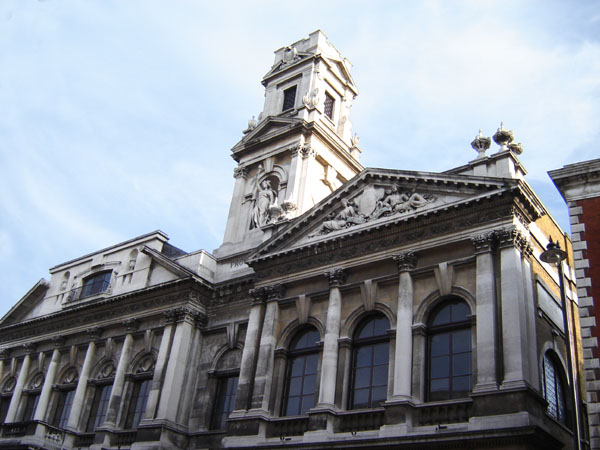
(public domain image of Shoreditch Town Hall from Wikimedia Commons)
Monday, 29 September 2008
Early Morning at Canary Wharf

6.40 am: On the train from Plumstead to Greenwich - About half of the passengers on the train are dressed in suits. The other half look like construction workers. There is not much conversation - people keep themselves to themselves. The men mostly read newspapers and the women, novels. Only the Polish, of whom there are quite a few, talk to each other.
7.50am: Outside Carluccio's at Canary Wharf - Share prices scroll past on the side of the building opposite. There are clocks every few feet along the pavement ... time is money ...People arrive in swarms with each incoming tube train. Nobody smiles. Women wear suits with trainers - their smart office shoes in bags, to be put on at the last minute. Only about half of the men are wearing ties ... dress-down Friday? Do they still do that?

8.10am: A few school-children join the throngs. A man filming at the top of the steps with a tripod is stopped for the third time by the police. Wearily showing his permission letter again, he films on.
The most cheerful person to be seen is a whistling street-cleaner in a bright red fleece.
A few people are carrying weekend cases and one or two have sets of golf-clubs. The weekend beckons. Nobody seems to look at the scrolling share prices. I try to work out which of the women are secretaries and receptionists: I have a theory that they are the ones with great big handbags.
Below the stairs, a string of people enter the building, each holding the door for the next in line. They smile at each other!

News comes through on the Reuters screen that the American bail-out deal has not yet been agreed. The scrolling share prices, previously a mixture of ups and downs, are now all resolutely down.
8.30am: People are still streaming through from the tube to the building, and a few very young men with oily hair and problem skin are wandering about with cardboard trays of coffees ... office juniors on the "bun run".
Sunday, 28 September 2008
A pertinent quote by Jane Jacobs ...
"A natural ecosystem is defined as "composed of physical-chemical-biological processes active within a space-time unit of any magnitude." A city ecosystem is composed of physical-economic-ethical processes active at a given time within a city and its close dependencies. I've made up this definition, by analogy.
The two sorts of ecosystems-one created by nature, the other by human beings-have fundamental principles in common. For instance, both types of ecosystems-assuming they are not barren-require much diversity to sustain themselves. In both cases, the diversity develops organically over time, and the varied components are interdependent in complex ways. The more niches for diversity of life and livelihoods in either kind of ecosystem, the greater its carrying capacity for life. In both types of ecosystems, many small and obscure components-easily overlooked by superficial observation can be vital to the whole, far out of proportion to their own tininess of scale or aggregate quantities. In natural ecosystems, gene pools are fundamental treasures. In city ecosystems, kinds of work are fundamental treasures; furthermore, forms of work not only reproduce themselves in newly created proliferating organizations, they also hybridize, and even mutate into unprecedented kinds of work. And because of their complex interdependencies of components, both kinds of ecosystems are vulnerable and fragile, easily disrupted or destroyed."
(my bold type)
This is from the foreword to The Death and Life of Great American Cities (Vintage, 1992). Earlier in the same foreword, Jacobs refers specifically to Canary Wharf ...
Urban renewal and slum clearance succumbed to their own failures and fiascos, after continuing with their extravagant outrages for many years after this book was published. Even now they pop up when wishful thinking and forgetfulness set in, abetted by sufficient cataclysmic money lent to developers and sufficient political hubris and public subsidies. A recent example, for instance, is the grandiose but bankrupt Canary Wharf project set in isolation in what were London's dilapidated docklands and the demolished, modest Isle of Dogs community, beloved by its inhabitants.
How have things changed for Canary Wharf since 1992? Obviously the development is no longer bankrupt (although that may change soon owing to the economic downturn), but can it be said to work as a community? There is now an amount of residential and entertainment development within the area, but does it still suffer from the effects of being a "plonked-down" development, rather than one which has grown organically from a natural intersection of pedestrian routes? To test this it would be necessary to visit at several times of day, and at weekends, and to talk to local residents, workers and revellers.
Saturday, 27 September 2008
"collaboration"_kimi,s view
It is essential for all social life.
collaboration's synonym =>. teamwork, partnership, cooperation, association, alliance...
Thursday, 25 September 2008
Evie's view on collaboration
London is the proper "fond" for such experiments, so tomorrow we expect to collect some food for thought..
Stuarts Take On Collaboration
col·lab·o·ra·tion
–noun
1. the act or process of collaborating.
2. a product resulting from collaboration: This dictionary is a collaboration of many minds.
[Origin: 1855–60; < F < LL collabōrāt(us) (see collaborate) + F -ion -ion]
Dictionary.com Unabridged (v 1.1)
Based on the Random House Unabridged Dictionary, © Random House, Inc. 2006.
Collaboration is the helping people out or working together as a team, Ravensbourne is the perfect enviroment to see collaboration between Cultures and Peers.
Within London these defined areas are not so easy to find, but can be mistaken for altrusim where people offer assistans for no particular reason.
Dictionary.com Unabridged (v 1.1) - Cite This Source - Share This
al·tru·ism
–noun
1. the principle or practice of unselfish concern for or devotion to the welfare of others (opposed to egoism).
2. Animal Behavior. behavior by an animal that may be to its disadvantage but that benefits others of its kind, as a warning cry that reveals the location of the caller to a predator.
The Collaborations within both environments will hopefully be investigated within our peice.
Fridays task
To prepare for this trip I have begun researching the various spaces and have begun posting videos and links that will supply a brief knowledge of the different places.
Bumblebee View On Collaborations!
However this perceptions will be challenged and documented. Do students/staff really come together at Ravensbournes to make a strong and sustainable networking environment?
Equally the perceptions of the London's environment will be challenged to see how people within the city interact and whether this will change at certain times of the day, IE rush hour verse evening entertainment hours.
Adding to this does the perceptions of the city change with regard to the persons background IE an International student verses an English students perception.
Some dictionary definitions ...
(from Dictionary.com Unabridged (v 1.1)
Based on the Random House Unabridged Dictionary, © Random House, Inc. 2006.)
collaborate [kuh-lab-uh-reyt]
–verb (used without object), -rated, -rating.
1. to work, one with another; cooperate, as on a literary work: They collaborated on a novel.
2. to cooperate, usually willingly, with an enemy nation, esp. with an enemy occupying one's country: He collaborated with the Nazis during World War II.
[Origin: 1870–75; LL collabōrātus (ptp. of collabōrāre), equiv. to col- col-1 + labor work + -ātus -ate1]
—Related forms
collaborator, noun
—Synonyms. collude, join, assist, abet.
collaboration [kuh-lab-uh-rey-shuhn]
–noun
1. the act or process of collaborating.
2. a product resulting from collaboration: This dictionary is a collaboration of many minds.
We discussed as a group the difference between collaboration, altruism and symbiosis ...
altruism [al-troo-iz-uhm]
–noun
1. the principle or practice of unselfish concern for or devotion to the welfare of others (opposed to egoism).
2. Animal Behavior. behavior by an animal that may be to its disadvantage but that benefits others of its kind, as a warning cry that reveals the location of the caller to a predator.
[Origin: 1850–55; F altruisme, equiv. to autru(i) others (VL *alterui, obl. form of L alter other (F autre), with -ui from cui to whom; -l- restored from L alter) + -isme -ism; popularized through trans. of A. Comte, who perh. coined it, on the model of égoisme egoism]
symbiosis [sim-bee-oh-sis, -bahy-]
–noun, plural -ses [-seez]
1. Biology.
a.the living together of two dissimilar organisms, as in mutualism, commensalism, amensalism, or parasitism.
b.(formerly) mutualism (def. 1).
2. Psychiatry. a relationship between two people in which each person is dependent upon and receives reinforcement, whether beneficial or detrimental, from the other.
3. Psychoanalysis. the relationship between an infant and its mother in which the infant is dependent on the mother both physically and emotionally.
4. any interdependent or mutually beneficial relationship between two persons, groups, etc.
[Origin: 1615–25; Gk symbíōsis, equiv. to sym- sym- + biō (var. s. of bioûn to live) + -sis -sis]
—Related formssymbiotic [sim-bee-ot-ik, -bahy-], symbiotical, adjective
symbiotically, adverb
We felt that collaboration was closer to symbiosis than altruism.
What about synergy?
synergy [sin-er-jee]
–noun, plural -gies.
1. combined action or functioning; synergism.
2. the cooperative action of two or more muscles, nerves, or the like.
3. the cooperative action of two or more stimuli or drugs.
[Origin: 1650–60; NL synergia Gk synergía, equiv. to synerg(ós)]
—Related forms
synergic [si-nur-jik], adjective
So symbiosis and synergy are both close in meaning to collaboration. They are also both terms most commonly used in biology, which made me wonder whether collaboration need necessarily always be a conscious, intentional thing. A bee and a flower could be said to work collaboratively. A college, a city, a language, an economy could all be thought of in terms of large-scale collaborative efforts, which made me begin to think in terms of Deleuzian Rhizomes ...
The question I am left with is, what is not a collaboration?


